
Edwards 72-Hour List Status
No official Edwards County site offers a 72-hour jail release view. The Sheriff’s page has agency contacts, basic jail facts, and a social link. It has no current inmate roster, three-day release tool, booking detail, photo gallery, app, cadence statement, or online retention policy. The official sitemap likewise shows no recent-release endpoint linked by Edwards County.
This absence must be stated on its own. It is not enough to stretch a same-day check or a current roster into three days of history. A person who is missing from a custody display may have bonded out, completed time, transferred to KDOC, entered another jail, moved under federal or immigration authority, or had a record corrected or restricted. Only the event record can separate those outcomes.
Define Edwards Three-Day Releases
A 72-hour question needs clear boundaries. State the start and end dates and times. A phrase such as “the past three days” can change while staff process a request, and it may conceal whether the period crosses a weekend. A fixed range lets the Sheriff search the form in which the records are maintained.
- Identify the named person, spelling variants, and approximate booking period. Include a birth date only when legitimately known.
- Set an exact start and end for the 72-hour span. Note the local date and time when any online source was checked.
- Ask the Sheriff for the existing prisoner-calendar entry and release instrument within that range. Request liberation time and authority.
- Check Kansas VINELink for a county-jail custody change. A transfer notice and a release notice must be read as different results.
- Review the Edwards County court case for bond, dismissal, sentence, probation, or another legal event, then reconcile it with the physical-custody record.
- Follow any documented transfer to its receiving system. Use KASPER only for KDOC-associated custody, not an ordinary county stay.
The Edwards County 24-hour release workflow is better when the exact day is known and speed matters. The three-day route is designed for an uncertain or wider period.
Edwards 72-Hour Record Fields
Edwards County does not publish screen columns for a three-day list. The fields below are precise targets found in the statutory jail calendar or related release instrument. They should not be promised as an online result, and details beyond the open calendar may require review.
| Field target | Role in a three-day check |
|---|---|
| Name and abode | Helps identify the person tied to the calendar entry. |
| Commitment time | Marks the beginning of the recorded Edwards County jail period. |
| Discharge or liberation time | Places the event inside or outside the defined 72-hour range. |
| Cause and authority | Shows the basis for custody and the authority for the later event. |
| Release instrument | Supplies the existing directive kept by the Sheriff. |
| Destination, if open and recorded | Helps distinguish return to the community from transfer. |
Ask separately for a case number, charge, booking identifier, or destination when those items are needed and maintained. Not every field will appear in every record. If a file combines open and protected information, request the segregable open portions rather than demanding the whole file.
Edwards Weekend Release Windows
A three-day range often crosses Saturday, Sunday, or a holiday. Edwards County has not published a weekend-release rule or a local processing timetable. The Sheriff’s stated weekday office hours are administrative hours. They do not prove that jail releases occur only while the public counter is open, nor do they shift a Sunday date to Friday.
Court, jail, VINE, and KASPER timestamps can appear in different order. A court may enter an order before physical processing ends. VINE can receive the jail event later. KASPER updates on working days, so a state transfer or status change may not appear during a weekend. A 72-hour range catches more dates, but each timestamp still belongs to its own source.
Record the source name, status, and access time. If two sources seem to conflict, ask what event each one measures. The calendar’s liberation time addresses local physical custody. The court register addresses legal action. KASPER addresses a state corrections record. None should silently overwrite another.
Note: No verified Edwards County holiday release policy exists, so do not predict a release date from the day of the week.
Request Edwards Three-Day Records
A focused KORA request should seek existing calendar entries in the defined range. Kansas open-records law does not force an office to create a new 72-hour spreadsheet, answer “who got out,” or perform analysis that no maintained record contains. Naming a person is the cleanest approach. If a broader range is truly needed, ask for existing entries in the form maintained and be ready for search, review, redaction, computer, or copy costs.
Ask for the entry’s commitment and liberation date and time, the cause and authority, and the related release instrument. When a transfer is at issue, ask whether a destination is recorded and open. The Sheriff may require a reasonable cost estimate or prepayment. No Edwards County fixed fee for this request was published, so a dollar figure should not be inferred.
The agency must act as soon as possible and generally by the end of the third business day. That response can provide the records, deny access under identified law, or explain a delay and give the earliest availability details. It is not a guarantee of production within three days. If only part of a record is closed, request separation of the closed content and production of the open remainder.
Edwards Three-Day Source Roles
The broader window can involve more than one custodian. Use the Sheriff for the county jail event, Kansas VINELink for a participating county-jail notice, and District Court records for the underlying case. If the Sheriff documents delivery to the Secretary of Corrections, KASPER becomes the persistent state source.
| Source | What it may confirm | What it cannot prove alone |
|---|---|---|
| Edwards County Sheriff | Local liberation time and authority. | Later case completion or final discharge. |
| Kansas VINE | Named county-jail release, transfer, or escape notice. | A durable release certificate or KDOC status. |
| District Court | Bond, dismissal, judgment, sentence, probation, or satisfaction where public. | The exact time the jail completed departure. |
| KASPER | KDOC incarceration, movement, release to supervision, or discharge. | An ordinary Edwards County booking not committed to KDOC. |
| Federal or immigration tools | Facts within their systems when a connection exists. | A county event with no federal or immigration link. |
Federal Bureau of Prisons records can show a federal release date. The U.S. Marshals Service has no public person locator, so a federal docket, holding facility, and later BOP record may be needed. ICE’s locator has its own limited recent-release scope. These are edge paths, not substitutes for the Edwards calendar.
Edwards Has No 72-Hour Endpoint
The Edwards County sitemap is the official evidence source used to check for a roster or recent-release page. Its captured view does not expose a jail release endpoint.
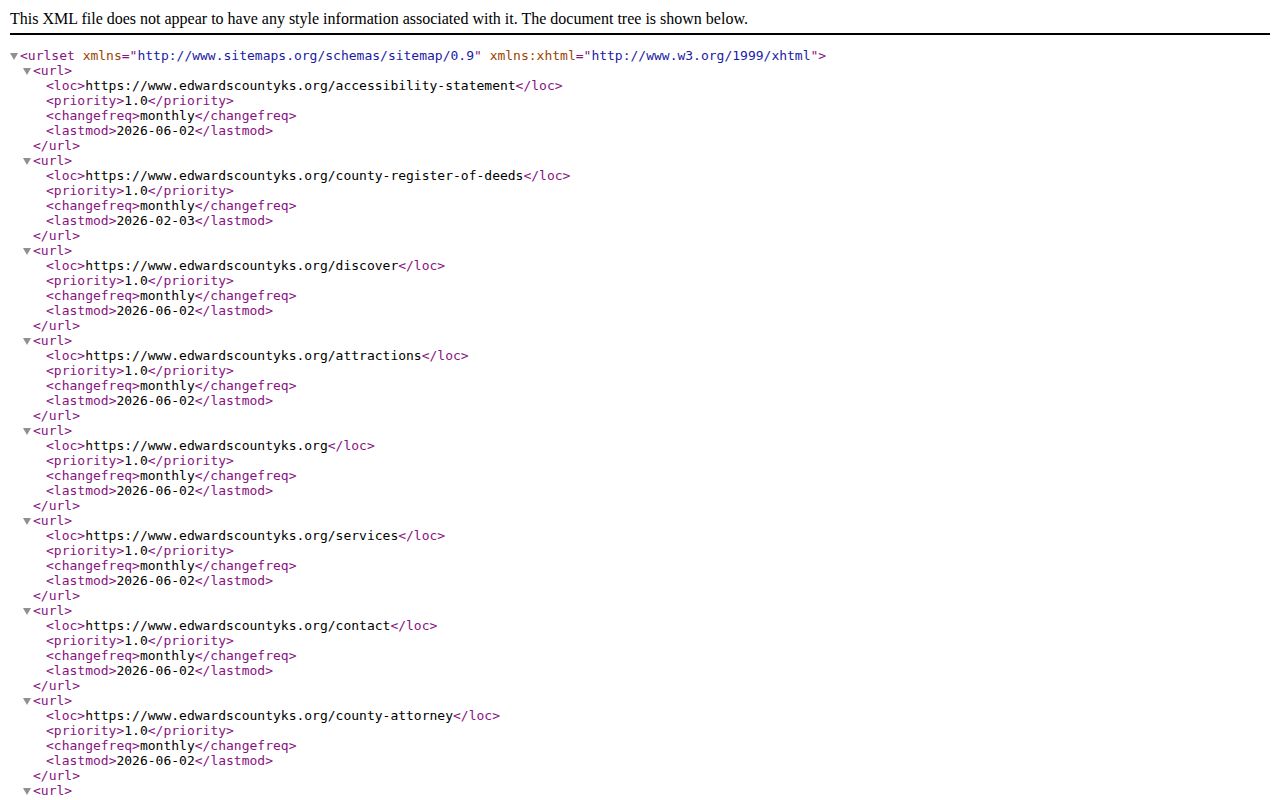
The screenshot supports the online absence finding. It does not prove that internal records do not exist or that the county could not add a vendor later.
The Kansas prisoner-calendar statute supplies the durable alternative. It requires exact information about commitment and liberation. That official record is fundamentally different from a short web window and remains the right target when the release date spans several days.
Interpret Edwards Release Outcomes
Bond ends custody in the named matter while the case can remain pending. Time served can end a jail term while other duties or cases remain. A dismissal or acquittal resolves the identified prosecution but does not itself state when physical custody ended. Probation is court supervision and is not proof of prison release. Final discharge is a later milestone that can end corrections authority.
Transfer is the most common trap. A person may leave Edwards County Jail for KDOC, another county jail, guarded medical care, federal custody, or immigration custody. That departure can fall within the same 72-hour span as a true community release. Describe only the event supported by the authority field and receiving-system record.