
Edwards County Jail Release Paths
The Edwards County Sheriff acts on the authority that controls each jail departure. Bond or sentence completion may return a person to the community. Dismissal or acquittal can end the identified case, but another case or hold may remain. Probation can place a person under court supervision. A transfer to the Kansas Department of Corrections, another county jail, a guarded medical setting, the U.S. Marshals Service, or immigration custody is not a community release.
The statutory prisoner calendar is the best local record of when and by what authority the person was liberated from Edwards County custody. The related release instrument supplies the underlying authority, such as a court order, bond document, sentence-completion directive, or transfer paper. If the instrument identifies delivery to another custodian, follow that agency’s system. Never describe local roster disappearance as “released home” without checking the destination.
| Departure | What follows | Verification source |
|---|---|---|
| Bond or time served | Possible community return | Sheriff calendar and court register |
| Probation | Court supervision | Sentencing order and supervising office |
| KDOC commitment | State incarceration | KASPER status and movements |
| Other jail transfer | Custody continues elsewhere | Release instrument, receiving jail, VINE |
| Federal or ICE transfer | Separate custody system | Federal docket, USMS, BOP, or ICE |
Confirm Edwards County Jail Release
Start with identity. Use the full name, date of birth if legitimately known, approximate booking dates, and court case number. Kansas VINELink can show a named person in a participating county jail and can report a custody change, but it is not a durable release certificate. VINE covers release, transfer, and escape notices, which are not interchangeable. It does not cover KDOC prisons.
- Search Kansas VINELink for the person and match the Edwards County facility and available descriptors.
- Ask the Sheriff whether the prisoner calendar records liberation, the exact date and time, and the authority.
- Request the existing release instrument tied to that calendar entry.
- Search the Kansas District Court portal and narrow the case to Edwards County.
- If the record says KDOC transfer, use KASPER. For another custodian, use that agency’s official source.
A court register may show bond, dismissal, judgment, sentence, probation, revocation, or satisfaction. It explains legal action but cannot prove another hold did not remain. KASPER can show a state movement, incarceration, parole, postrelease supervision, conditional release, or discharge. A no-hit in any one source leaves the question unresolved.
Record the source name and access time when comparing systems. County jail data, court filing entries, VINE notices, and KASPER updates do not post on one schedule. A short mismatch may reflect processing time rather than an error. If dates or status remain inconsistent, ask the agency that created the disputed record. A sheriff-calendar issue belongs with the Sheriff, a docket issue with the court, and a KASPER issue with KDOC.
Edwards County Jail Release Records
K.S.A. 19-1904 requires a true and exact prisoner calendar stating the name, abode, commitment time, discharge time, cause and authority of commitment, description, and the time and authority of liberation. Kansas Attorney General Opinion 87-25 describes the jail book as open and identifies related fields, including the commitment and discharge date and hour. K.S.A. 19-1911 requires the sheriff to endorse, file, and safely keep each commitment or release instrument.
A narrow request should ask for the named person’s calendar entry and existing release instrument during a defined period. Request the commitment and liberation date and time, cause and authority, release disposition, case number, and destination when recorded and open. Do not ask why staff made a decision when the actual need is the existing record. Kansas open-records law does not require an agency to create a new answer or compile a custom report.
Reasonable actual search, review, redaction, computer, and copy costs may apply, and the agency may seek an estimate or prepayment. No Edwards-specific release-record fee is published. The agency must act as soon as possible and by the end of the third business day, but that first response may give a reason for delay and an availability date. If a portion is closed, ask for the segregable open remainder. Protected medical, juvenile, investigative, victim, or other content should not be demanded.
Edwards County Jail Contact
The official Sheriff page is the source for facility and office details. Telephone, mail, an in-person visit during public administrative hours, or a written Kansas Open Records Act request are the documented local access channels. The county’s general contact form may route a message, but a direct request to the records custodian is clearer.
Edwards County Sheriff’s Office and Jail312 Massachusetts Avenue
Kinsley, KS 67547
Mail: P.O. Box 271
620-659-3011 or 620-659-3012
Administrative hours: Monday through Friday, 8:00 a.m. to 5:00 p.m.; closed holidays
Those hours describe the public office, not release processing. The jail’s custodial operation does not stop when the counter closes. No official release door, schedule, weekend rule, holiday procedure, waiting area, or property-return process was found. Call before travel and do not assume that a released person exits through the public office.
Small Edwards County Jail
The official page states that Edwards County Jail has a maximum capacity of 12 beds and normally houses no more than nine people. It is maintained by the Edwards County Sheriff’s Office. This small facility differs from a large metropolitan jail that may operate a vendor roster, booking-photo gallery, and rolling release archive. Edwards County publishes direct agency contact information but no comparable data product.
Direct contact does not mean staff must instantly answer a broad inquiry, create a new list, or waive lawful costs. The useful advantage is precision: a request for one identified prisoner-calendar entry and its release instrument points to the exact statutory records. The county jail’s scale explains its direct-contact publishing model, but it does not reduce the need for documentary proof.
The official Sheriff page displays the facility facts and contact channel used for a release-record request.

The page provides no current roster or release list, so its contact details lead to the statutory record rather than an online booking result.
Edwards County Jail Online Limits
No official Edwards County roster, recent-release feed, booking detail page, photo gallery, mobile app, update cadence, or online retention window was verified. The official county sitemap likewise exposes no inmate-search, roster, booking, or 24-hour and 72-hour release endpoint. This is a finding about the reviewed official web pages, not a claim that the Sheriff keeps no internal jail system.
The county sitemap capture documents the online boundary relevant to an Edwards County Jail release search.
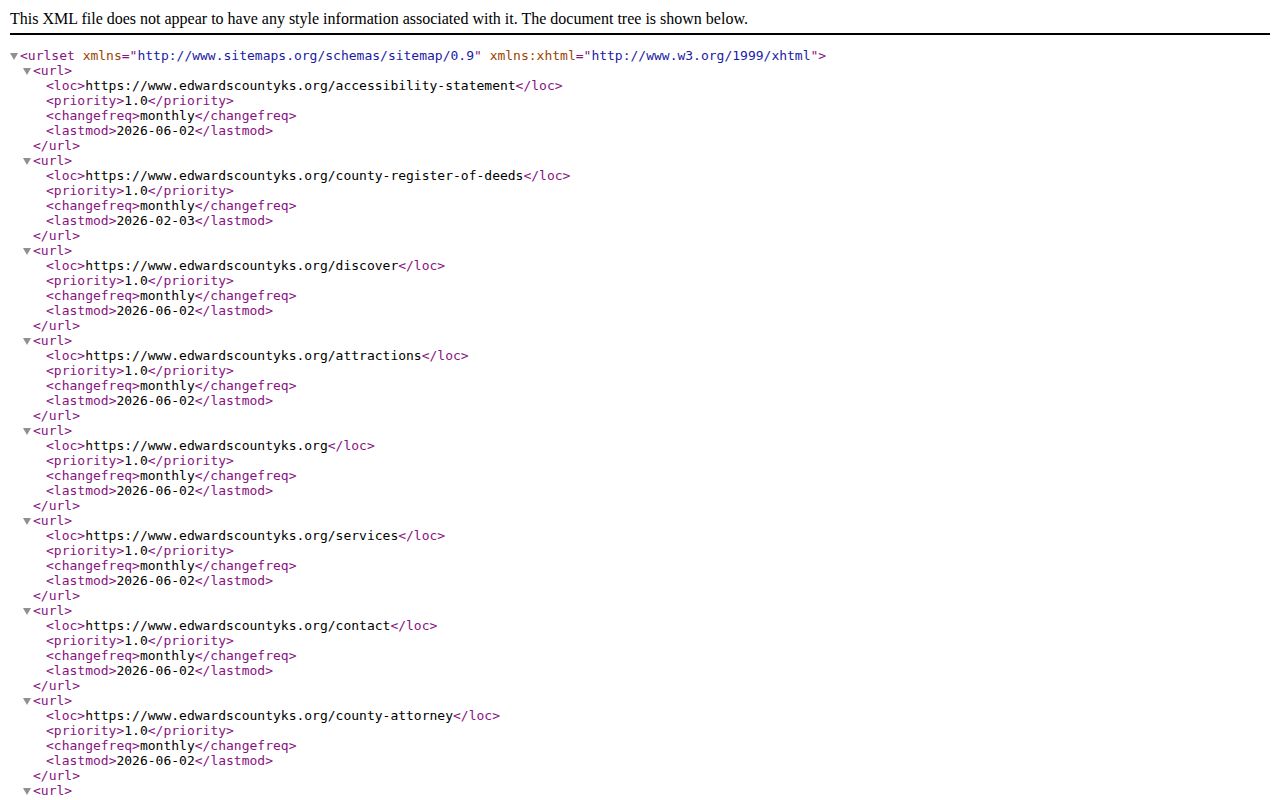
An absent web feed does not erase the prisoner calendar required by law. It makes the calendar and release instrument the primary local evidence rather than a secondary fallback.
Edwards Jail Court and KDOC
Edwards County is part of the 24th Judicial District. Public district-court information is available through the statewide portal, while older or public records that are not remotely available may require a free courthouse terminal or written clerk request. The court disposition can outlive the jail stay. It should still be reconciled with the physical-release time and authority recorded by the Sheriff.
No KDOC prison was identified in Edwards County. If a person was convicted and delivered to the Secretary of Corrections, KASPER becomes the persistent state record. Search by KDOC number when available, or use name, alias, birth date or age, conviction county, location, and other fields. “Incarcerated” means state custody continues. Parole, conditional release, or postrelease means physical prison release with supervision. “Discharged” marks the end of the KDOC obligation.
Federal and immigration paths apply only when the record shows that connection. A USMS detainee can leave a local jail for another contract facility or later BOP custody. ICE ODLS has its own identity rules and limited recent-release coverage. Neither a transfer nor removal should be reported as a return to the Edwards County community.
Final discharge is distinct from leaving this jail. For a KDOC sentence, use a KASPER discharged status, discharged date, or an official discharge certificate. For probation, seek the court discharge order or confirmation from the supervising agency. Recent community-corrections events may not appear in KASPER because of the state system’s modernization gap. The earlier Edwards County Jail calendar still proves when local custody ended, but it cannot establish when later supervision ended.